
Adams County City Directory Collections
Start at Denver Public Library's Colorado Directories Index, alongside Anythink and History Colorado. That trio holds the strongest Adams-area runs. The collection map keeps the known holdings distinct from one another. Some entries are index leads only. They do not promise that every annual volume sits on a scanner. Ask the holding library for the exact edition, call number, and page range. Also ask whether a reverse street section survives.
| Collection | Years or run | Where held | Access |
|---|---|---|---|
| Polk's Denver Suburban Directory | 1975; 1976 parts 1 and 2 | DPL Building History Area, Level 5 | Index/material check with DPL |
| Brighton telephone books | 1980/81 lead | Denver Public Library index and holdings | Verify annual format and call number |
| STX-2 Brighton directories | Municipality/year leads | Denver Public Library index | Filter by place and year |
| Brighton local or market directories | About 1953 through 1969 | History Colorado Hart Research Center | Appointment or virtual request |
| Obituary and local newspaper databases | HeritageHub 1704 to today; newspapers by title | Anythink branches and catalog | Card or branch access may apply |
These formats serve different purposes. A telephone book may sort by number or address. A suburban volume might add occupation, spouse, business, or street detail. The keeper and the edition date are part of the evidence.
Anythink Adams County Directory History
Anythink is the public library system for Adams County, with a catalog and seven branches. Its History & Genealogy shelf includes HeritageHub obituary and death notices from 1704 to today. It also includes Black Life in America, Hispanic Life in America, MyHeritage, History Reference Source, and Ancestry Library Edition. Ancestry access is branch-only. Card-only resources require an Anythink card. The Denver Post Collection runs from 1989 to current. Anythink points to current or archived Commerce City Sentinel and Brighton Standard Blade material.
A library search can surface a dated notice. It can also surface an address spelling, a civic event, or a family connection. Record the publication title, date, page, database name, and search terms. A notice places a household in time. It does not prove the same person lives at that address today. Branch staff can clarify whether an item is print, microfilm, licensed database content, or an interlibrary request.
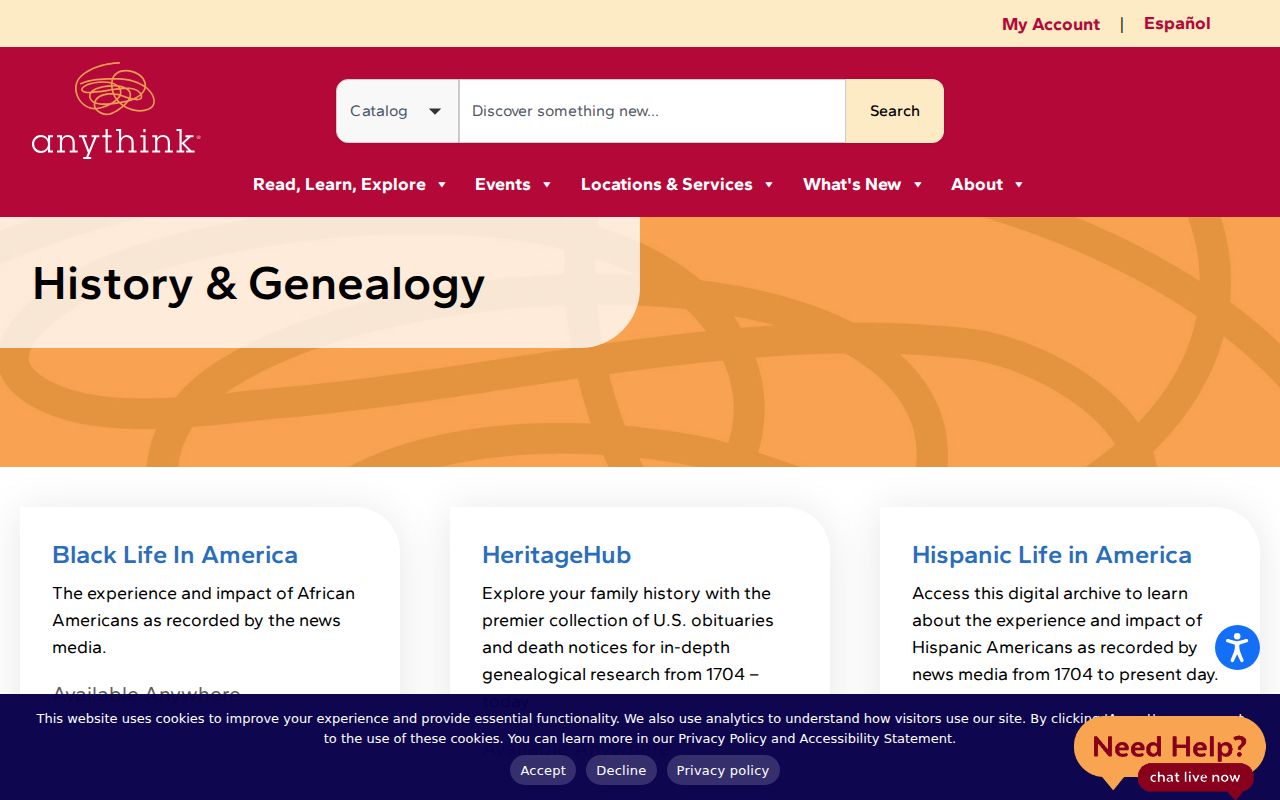
The Anythink History and Genealogy page opens the route to the listed databases. It also carries local newspaper leads.
The Anythink page displays the library's genealogy and history resource shelf. It shows research access rather than a directory page listing a current resident.
Where you sit changes the route. The same Adams County city directory question may resolve differently from home, a library computer, or a staff-assisted request.
Adams County Directory Index at DPL
Denver Public Library's Colorado Directories Index arranges city directories and telephone books by municipality or county. It also sorts them by year. Filter by place before running broad keyword searches for Adams County. Polk's Denver Suburban Directory covers Adams County numbers with a household and business street directory. It adds a buyers' guide and classified section. It also includes a numerical telephone directory. Brighton telephone-book and STX-2 leads work best as collection pointers until the catalog confirms the edition.
DPL places its Building History Area on Level 5. An online index may show that a volume exists. But the page image stays inside the building, on microfilm, or behind a staff request. A large request may hit an appointment or daily limit. Ask for the exact page and call number rather than a blanket sweep for every Adams County resident.
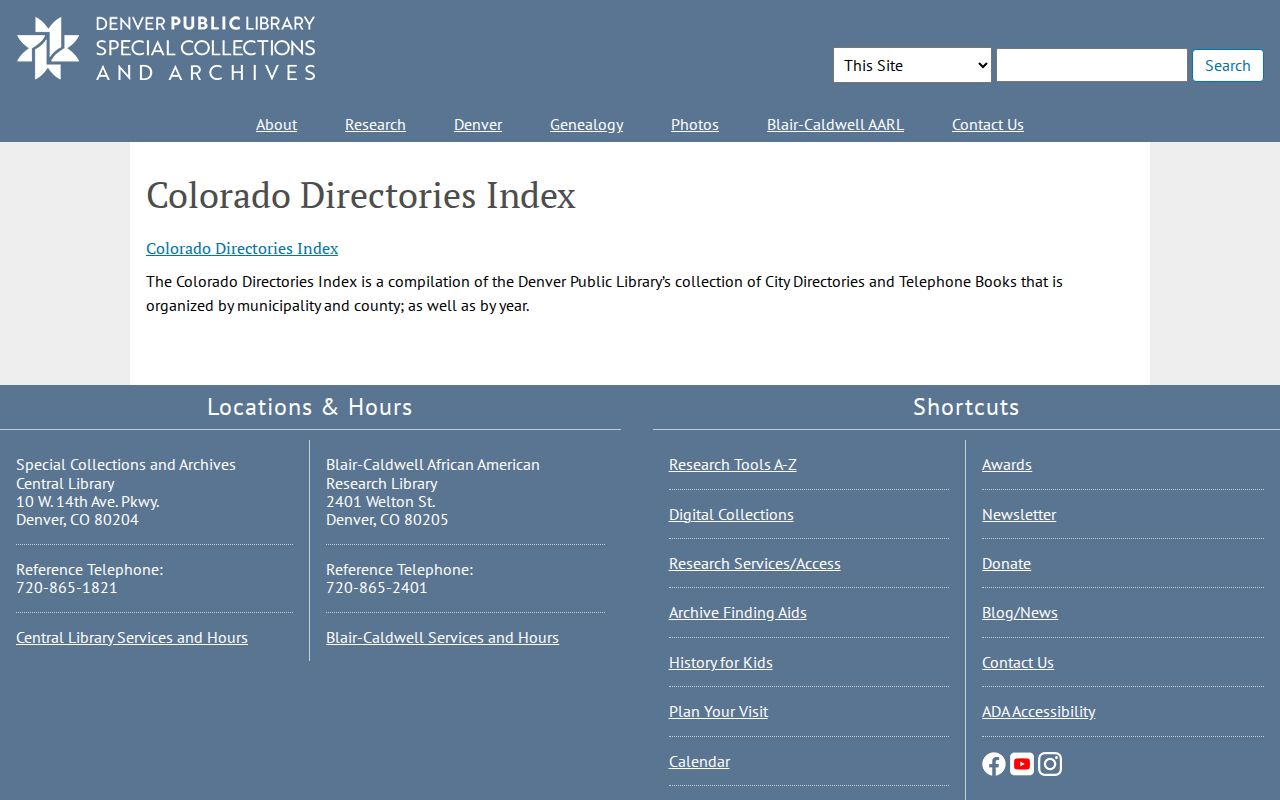
The DPL Colorado Directories Index supplies the municipality and year structure.
The DPL index page shows the place-and-year organization plainly. Cite it beside the edition and page. Do not treat it as proof that every listed name remains current.
Once a volume turns up, transcribe the entry and its abbreviation key before comparing it with a modern parcel or recorder search. Small print carries real meaning. Note: DPL index coverage does not guarantee a digitized page image or a complete annual run.
Brighton Adams County Directory Years
Brighton is the most visible Adams County place in the historical collection leads. History Colorado describes a Brighton city or local-market directory tied to Rocky Mountain Directory Co, XL Directory Service, and Johnson Publishing. Its material falls around 1953, 1955, and 1969. DPL's index adds Brighton telephone-book leads around 1980 and 1981. That trail runs from mid-century to late century. It does not establish a complete annual series.
Publisher changes affect what an entry means. One edition may list householders and occupations. Another may emphasize telephone service or businesses. A reverse section was kept in a separate volume. Preserve the title as printed, the publisher, municipality, edition year, page, and holding institution. Do not flatten "Brighton," "Adams County," and a delivery city into one boundary.
- About 1953: History Colorado's Brighton local or market directory lead begins the mid-century trail.
- 1955 and 1969: XL Directory Service and Johnson Publishing are named in the catalog description.
- 1975-1976: Polk's Denver Suburban Directory material includes Adams-area household and street information.
- 1980-1981: DPL index snippets identify Brighton telephone-book leads for later comparison.
Adams County Telephone and Criss-Cross Books
Directory books come in several shapes, the Library of Congress explains. Some list names alphabetically by surname. Others key entries to an address or telephone number. Some volumes split city-business listings from a criss-cross section. A criss-cross directory works in reverse. You start with an address or phone number and move toward a name. When placing a request, state the format you need. Include the city or county, the state, and the exact years. Colorado material covers much of the twentieth century. Only part of the United States Telephone Directory Collection appears online.
Copy a reverse entry completely. Record the street number and street name. Note the unit or rural-route notation, municipality, printed telephone, household or business marker, and the abbreviation key. Keep in mind that a telephone listing can be unlisted, shared, or disconnected. The book proves how a source printed an address in one year. It cannot certify who lives there now.
- Criss-cross directory
- A reverse directory searched by address or telephone rather than only by surname.
- Householder index
- A directory list that points to the person or household associated with an address in that edition.
- Abbreviation key
- The publisher's explanation for occupation, marital, business, or address marks.
History Colorado Adams Directories
History Colorado's catalog sits on a different shelf from DPL's index. Its Brighton local and market directory records name three publishers. They are Rocky Mountain Directory Co, XL Directory Service, and Johnson Publishing. The Hart Research Center handles viewing and research access. Hours run Wednesday through Saturday, 10 AM to 3 PM, by appointment. Virtual contact works through cosearch@state.co.us and 303-866-2305. Confirm the current schedule before you travel.
A catalog record gives a publisher and a date clue. It does not offer a stable digital sample entry. No Brighton page image appears in the catalog. Ask staff whether the object can be viewed. Ask whether scanning is allowed, and which page or identifier should be cited. This is the right fallback when a DPL index lead stops short. It covers the gap left of the page itself.
History Colorado access is separate from a CORA request. A library or archive collection is not normally a county administrative record. Use the institution's own catalog, appointment system, email, or request form instead.
When a visit is impossible, ask for a title, publisher, year, call number, page range, and whether the volume contains a street-address or telephone section. That small request gives a librarian enough detail to find the right shelf. It also gives a future reader enough detail to repeat the search.
Note: Check History Colorado's appointment or request route before any trip today.
Reading an Adams County Directory Entry
Transcribe a directory entry before you interpret it. Start with the name exactly as printed. Then capture the spouse or household mark, the occupation or business category, the street and number, the municipality, the telephone, any widow or household notation, and the publisher, edition, and page. Resist turning a historical occupation into a present fact. Never silently correct an old spelling.
Pair the entry with a second dated anchor. A parcel or recorded document can test the address. A newspaper or obituary can test a life event. A later directory can test movement. When a historical entry needs a parcel comparison, the Adams County street directory carries the modern address-keyed chain.
- Collection, publisher, edition year, page, and call number
- Surname, given name, initials, spouse or household notation
- Street number, name, unit, rural route, municipality, and telephone
- Occupation, business, institution, or category exactly as printed
- Missing page, illegible scan, restriction, or no-result note
Adams County Records and Obituaries
Newspapers often supply the date a directory does not. Obituaries, marriage notices, civic appearances, business items, and address spellings surface through Anythink's HeritageHub, Denver Post material, the Commerce City Sentinel, and the Brighton Standard Blade. Use the publication date and page, not just the database result title. A notice may identify relatives or a former place. It will not establish a current address.
Trace a household across directory years with a small, dated sequence:
- Copy the earliest directory entry and cite publisher, year, page, and address.
- Check a later edition for the same surname, spouse mark, occupation, or street.
- Pair the years with released census schedules or a newspaper notice, keeping enumeration and publication dates separate.
- Test the address against a parcel, plat, deed, or map only after confirming the municipality.
- Write “not found in this edition” when a volume or page does not produce a match.
Limits of an Adams County City Directory
An Adams County city directory records what its publisher or library held at one moment. It may omit a household entirely. It may use a delivery city. It may list a business instead of a home, or repeat a name without enough detail to separate two people. A directory entry is not a current resident confirmation. It is also not a deed, a voter result, or a vital certificate. Attach the source year to every claim. That habit keeps past residents of Adams County distinct from present ones.
Historical-source rule. Preserve the collection, publisher, page, and date. Then verify an address or identity with a second independent source before describing a past household.
For material you cannot reach directly, lean on several routes. That means DPL's index and Building History Area, Anythink branch staff and card databases, History Colorado's Hart Research Center, the Library of Congress request guidance, or the State Archives dated series. A broad request for all Adams County residents goes nowhere fast. A specific edition, place, year, and page range works far better.
Note: A historical entry should keep its edition, page, publisher, and municipality. Compare it with modern records only after that.