
Adams County Previous Residents Sources
Era matters when you chase past residents of Adams County. Each local source covers its own stretch of years. The coverage table shows what a records office can supply and where it stops. Recorder indexes cut off online at an unpublished date, so older deed questions may need a direct Recording Department request. Directory and archive runs vary by series too. Adams County never promised that every edition survives.
| Source | Years or coverage | Where held | What it shows |
|---|---|---|---|
| Adams recorder index | Online start year not published | Clerk & Recorder / Landmark | Grantor, grantee, reception, document and legal-description chain |
| Brighton Sanborn sheet | September 1893 | Library of Congress | Buildings, uses, streets, hydrants, water mains, block clues |
| Brighton local directories | About 1953 through 1969 | History Colorado | Names, addresses, businesses, publisher context |
| Polk's Denver Suburban Directory | 1975; 1976 parts 1 and 2 | Denver Public Library | Adams-area household, business, street, and telephone material |
| Brighton telephone books | 1980/81 lead | DPL index and holdings | Telephone, address, and local directory clues |
| Thornton permits | 1993-2017; 2017-present | Thornton ArcGIS layers | Permit, address, parcel, status, legal-owner fields |
| State Archives series | 1902-1962 and series-specific ranges | Colorado State Archives | Vital, court, probate, naturalization, and coroner trails |
Match each source to the fact it can actually prove. A city directory fixes a name in one edition. A deed names the parties to one instrument. A Sanborn map only describes a built place. Taken alone, none of them shows who lives at an Adams County address today.
Adams County House-History Records
Start with the current street string and parcel account. Then work backward through the property rolls. The Assessor's SALES fields can expose RECPTNO, BOOK, PAGE, grantor, grantee, document date, sale date, sale price, and deed code. Landmark searches by reception number or by party. Keep the legal description and subdivision reference handy. A street name change can otherwise break the trail for past residents of Adams County.
For the household layer, turn to the city-directory shelf. A mid-century local-market volume may not be visible in the DPL index. The History Colorado Brighton directory record is a strong lead. The catalog entry displays the historical collection lead, though it shows no sample page. Cite it with its publisher and date description.
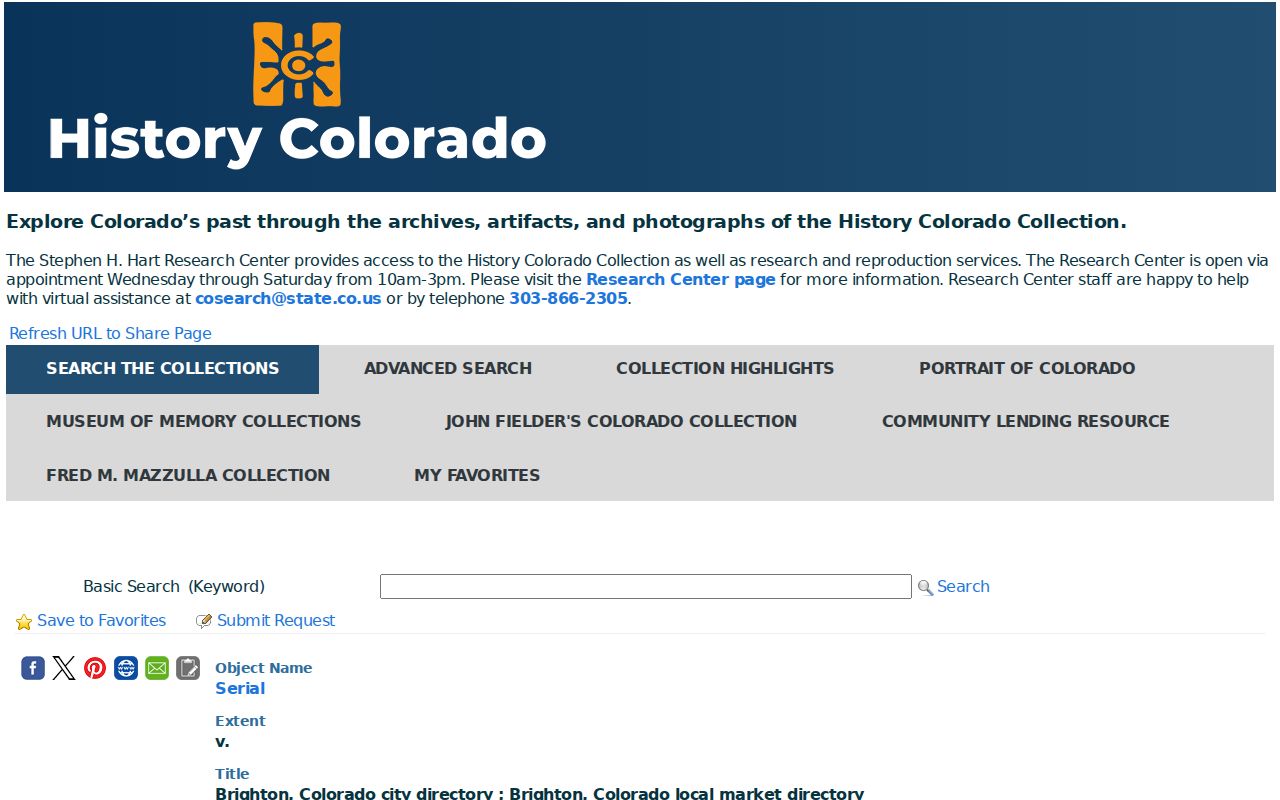
Contact the Hart Research Center for viewing, scan permission, the call number, and a page citation. Note: never infer an Adams County household from a catalog title alone.
Adams County Deed Records Backward
Walk an address backward through the deed chain in small steps. Begin at the current account's latest SALES row. Pull that reception number up in Landmark. Read the instrument's legal description to learn who the seller was. Then search that seller as an earlier grantee. Repeat with the next reception number. Keep recording date, execution date, and sale date separate. They are three distinct facts.
- Copy ACCOUNTNO, PARCELNB, RECPTNO, BOOK, PAGE, grantor, grantee, DOCDT, SALEDT, and document code.
- Open the named instrument or request the copy from the Recording Department.
- Compare the legal description, subdivision, block, lot, plat, and parcel references.
- Move from the prior grantee to the earlier instrument, preserving every reception number and gap.
- Use a directory, newspaper, map, or archive series to add household or place context for the dated interval.
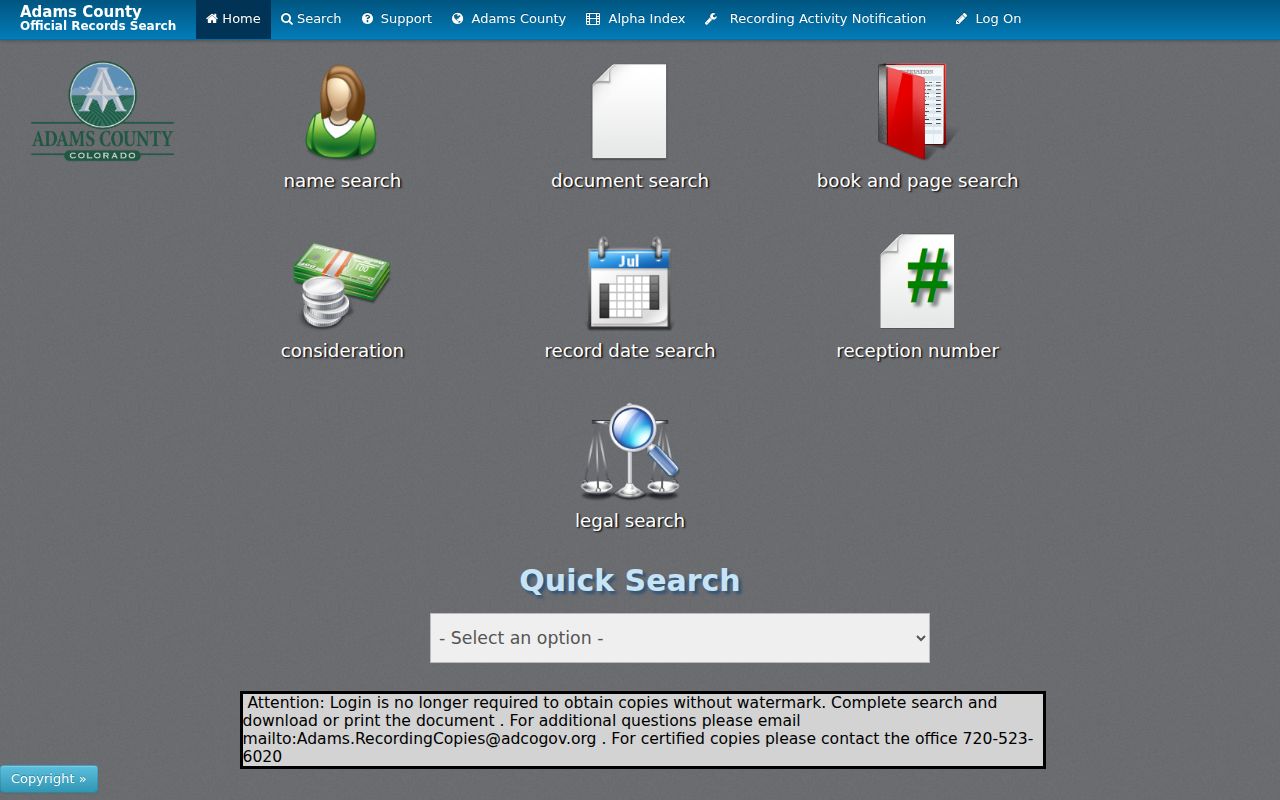
The Landmark search-mode page offers Name, Document, Book/Page, Consideration, date, reception, and legal searches, plus quick-search paths. Downloads now carry no watermark and no login. Certified copies still go through the office route. For anyone tracing past residents through the recorder's records, the search-mode page works as a source checkpoint rather than a private deed result.
Recording costs and delivery rules sit beside the request date on the fee schedule. Since July 1, 2025, recording runs $43 per document. Ordinary copies cost $0.25 per page. Certified copies add $1 per document.
- Grantor
- The party conveying or granting an interest in the recorded instrument.
- Grantee
- The party receiving the interest named in the instrument.
- Chain of title
- A sequence of recorded transfers that connects successive interests in land.
- Legal description
- The recorded land description used to identify the property beyond a street line.
Note: Landmark's grantor-grantee index lacks tract indexing, so searching by a known address may still require a party name.
Adams County Sanborn Records and Clues
The Library of Congress preserves a September 1893 Sanborn map of Brighton in Adams County. It is rich detail for house-history work. The sheets show building footprints, street names and widths, uses, property boundaries, and house or block numbers. Water mains and fire hydrants appear too. Before parcel records took over, this was the baseline a researcher had. A map, though, is not a deed. It never names every household on a street in Adams County.
A practical sequence works well. Start with the historic street and block. Then compare the footprint or building use against a directory entry. From there, locate the later subdivision or plat. Test the result against the current parcel in GIS and the assessor export. Cite the sheet and the date. If a building or street is missing from the map, say so plainly. Do not assume the map is complete.
The 1893 Brighton Sanborn record is the public source for the map description. It is also the route to the digital files.
Adams County Archive Records and Dates
The State Archives keeps older Adams County series. These do not behave like a modern web search. Birth and death material runs from 1902 through 1907. The Adams Coroner's Record covers 1903 through 1944. Marriage certificates span 1903 to 1975, licenses 1902 to 1958, and applications 1904 to 1912. Adams County divorce series reach from 1904 through 1992, while probate covers 1902 through 1962. Naturalization indexes, declarations, final documents, and petitions each have their own ranges. Most begin in the early twentieth century.
Restrictions differ by series. Divorce, probate, guardianship, and minors' material may require a case number, party status, identification, or a legal representative. So may any records under a stated age. For births and deaths after 1908, the current route points to CDPHE. An archive request should include the series, year, and name. It should also list case or index detail, and why the date range fits.
Access works both in person and virtually. It runs through the State Archives and the History Colorado Hart Research Center. A library or archive can supply an index or historical context for Adams County records. It cannot waive a current confidentiality rule.
Adams County Newspapers and Obituaries
A single newspaper item can bridge two directory years. An obituary, marriage notice, legal notice, or civic report may pin an Adams County family to a week and a place. Anythink gives researchers several newspaper collections. They include HeritageHub, the Denver Post Collection from 1989 to current, the Commerce City Sentinel, and the Brighton Standard Blade. Search each term separately: surname, street, business, spouse, place. Record the publication date, page, title, and database.
Newspaper evidence earns its weight when it agrees with a directory, deed, plat, or archive series. A notice can name a relative, a former address, a funeral location, or a business. That is not proof of where someone lived. Say "the notice printed" or "the directory listed" rather than upgrading an old item into a present fact.
Note: A newspaper notice supplies dated context, not a guarantee of a current address or household.
Adams County Plat Records and Reception Clues
Plat and subdivision packets bridge old and new. One county sample, PLT2025-00043, names three assessor parcels, Camas Subdivision Filing No. 5, nearby roads, a survey date, acreage, a FEMA panel, and a title-commitment date. Another packet, PRC2025-00007, ties vesting deed reception 2024000058460 to earlier conveyances 2021000043836 and 2021000079405. These are structural clues. They are not a title opinion or a residence claim.
Search a reception number before a person name when a land-use packet supplies one. Compare legal description, subdivision, block, lot, and parcel. Then look for breaks. A correction, split, merger, condominium account, easement, or new filing can disrupt the apparent chain. Keep the packet, deed, and assessor row separate. Treat each as its own source.
Historical Adams County Address Records
Old street strings rarely match modern formatting. Spellings, suffixes, unit formats, and numbering shift. Adams County documents no official countywide renumbering project with a verified year or a complete old-to-new street table. Connect versions with a parcel number, subdivision, reception number, plat, legal description, directory page, or municipal confirmation.
Never silently normalize an old address. Quote the source string exactly. Write the modern equivalent as a hypothesis. A city directory may call a place Brighton while a later deed or ZIP label uses another city. Treat the difference as a clue to jurisdiction or date, not an error to erase.
Past Adams County Resident Records
Previous-residents research works best when the address trail and the household trail meet. Use the city directory collection for the actual volumes. Use the deed chain for named parties, newspapers for dated notices, and the census for released household context. Pair directory years with census years carefully. Enumeration dates and publication dates are not the same. A household may move, a directory may omit it, and a parcel may hold more than one account.
- Anchor the address in a dated directory and copy the publisher, page, and street line.
- Pair that edition with a released census year, keeping the enumeration date distinct.
- Test the same name, spouse mark, or address in a newspaper or obituary.
- Use the parcel, deed, plat, or map trail to check whether the place stayed the same.
Lawful house history. Use past-address sources for genealogy, local history, heir work, and personal research. Do not compile a current-location profile or use an old entry to watch, contact, or harm anyone.
The parcel trail has a natural next step. When the question turns from past residents to the modern address, hand it off to the Adams County street directory. The historical volumes themselves belong with the city-directory collection route.
Adams County Resident-Record Claims
Write the source date beside every historical claim. Cite the directory publisher and page. Add the newspaper title and page, the map sheet, the archive series and year, the recorder reception number, the parcel file version, or the portal inspection date. Negative results deserve the same care. Name the system, the exact fields, the spelling tried, the date, and the coverage gap.
History complicates Adams County recordkeeping. The January 1904 temporary-courthouse fire destroyed the Daniel Carmichael residence. It also destroyed the county offices before Brighton's permanent county-seat record structure matured. Because of that loss, ask archives for series-level custody. Compare surviving books, directories, maps, and newspapers rather than assuming a continuous local file.
A good house-history note can hold both positive and negative evidence. A named deed sits next to a missing directory year. A map shows the structure; an archive series begins later. State the interval, the source, and the reason for the gap. Future research can then test the unresolved period without repeating a broad search.
Previous residents are a reconstruction. The most honest conclusion may be a dated chain with one unresolved interval. That beats a confident but unsupported name.
Note: A courthouse-fire gap is a custody question, not a space to fill with an assumed missing name.